

August 20, 2026
There Was No Playbook for HS Care. There Is One Now.
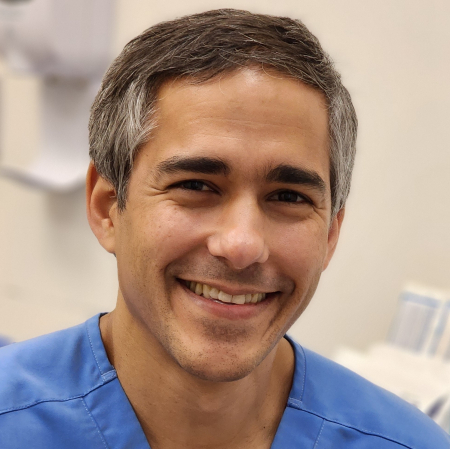
By Christopher Sayed, MD, Vice President, HS Foundation; Professor of Dermatology, University of North Carolina at Chapel Hill
When I finished my dermatology training at UNC in 2013, hidradenitis suppurativa was at the top of the list of diseases I did not feel ready to treat well. There were no FDA-approved therapies for HS at the time. There were very few experts across the country. And there was not much of anywhere to send patients who needed real help.
That gap was what pulled me into the disease. Twelve years later, I run a specialty HS clinic at UNC, serve as Vice President of the HS Foundation, and work as an investigator on many of the clinical trial programs producing the next generation of HS therapies. From that vantage point, the most important thing about where the field is today is not that we have new drugs, although we do. It is that HS is becoming a disease the community can treat, not something only the specialty clinics know how to manage.
What it took to build a practice
Building an HS practice in 2013 meant figuring out treatment approaches I had never had training in, and that few other dermatologists were doing at the time. The two clearest examples were infusion therapies and surgery.
Infliximab, the biologic that has become one of the most commonly used off-label therapies for HS, was not something dermatologists were trained to coordinate. Infusion protocols, monitoring, and patient counseling were things we typically referred to other specialists in our region. For HS patients who needed the drug and had nowhere else to get it, we had to learn to run the therapy ourselves.
Surgery was harder. HS surgery was not part of dermatology residency training. General and plastic surgeons were often not interested in HS patients, and I would send patients out and get them back untreated. What I did know was how to do surgery on the skin. I had the training. I started addressing the areas I could feasibly manage in clinic, and patients started asking me to do more.
How far the field has come
When I started giving talks about HS surgery in the years after that, I would sometimes find one or two people in a big room who had done surgery for HS themselves. Today, when I give the same talks, at least half of the room raises a hand. That is a measure of how the field has changed.
The comparison that comes to mind is psoriasis twenty-five years ago. Psoriasis was a specialist disease. There were specialty clinics because general dermatologists did not have the tools or the confidence to manage it. The therapies got better, the training expanded, and psoriasis is now something every general dermatologist treats. HS is not there yet, but it is on the same trajectory. Three FDA-approved therapies have changed the calculus. The pipeline behind them is going to change it further. As recently as a decade ago, dermatologists could reasonably say they did not have the tools to treat HS well. That excuse no longer exists.
The medication and surgery balance
The clinical point I most want other dermatologists to understand is that medication and surgery are complementary, and for most patients with meaningful disease, neither alone is enough.
Medications, including the current biologics, can control inflammation, prevent new lesions from forming, and reduce pain and drainage. For a subset of patients, medications are all they need. For most patients with the scarring and tunneling that develops over time, medications hit a limit. That scarring is a physical remodeling of the skin. It does not reverse with a drug. What you see clinically is that the disease quiets down, but specific areas keep flaring in the same spots. Patients often know exactly where these areas are. They can point to them.
Surgery addresses that physical remodeling, but surgery alone is not the answer either. If all we do is cut out active areas, the disease reappears somewhere else and the patient ends up in an endless cycle of procedures. Having surgery all the time is not much better than having HS all the time. The right approach for most patients combines both: medication to control the disease and prevent new lesions, surgery to address what medication cannot reach.
The pipeline, and how the guidelines will keep up with it
The pipeline over the next five to seven years is going to change what a treatment plan can look like. New oral options are coming, including JAK inhibitors, which is meaningful because HS currently has no approved oral therapies. Additional biologics in mechanism classes we already use are going to expand the bench, and even similar mechanisms sometimes give better responses in patients who did not respond to what came before. Earlier-stage work on other pathways, including IL-1 inhibition, is showing promising signals and still needs phase three data. The clinical implication is a deeper set of options for the patients who run out of choices today.
The joint AAD and HSF guidelines are the first to include a live-update process, and that mechanism matters more than it might appear. Focused updates will be driven by two events: phase three data that establishes strong evidence for a therapy, and FDA approvals that make a drug available for prescribing. Larger revisions on the standard five-year cycle will incorporate the accumulated smaller findings that build the evidence base in between. For a field where the pipeline is producing therapies faster than a five-year cycle can accommodate, that infrastructure is what keeps the guidelines relevant. Without it, the document would be dated within eighteen months of publication.
The guidelines are the most complete picture of HS care the field has ever produced. Whether they change patient outcomes will depend on what happens next: whether the clinicians who need them can find them, understand them, and put them into practice. That is the work still ahead of us.
For questions or comments please contact us here.
More detailed clinical perspective will follow in subsequent pieces in this series.
Found this helpful? Share it with your network — better-informed clinicians mean better outcomes for HS patients.